
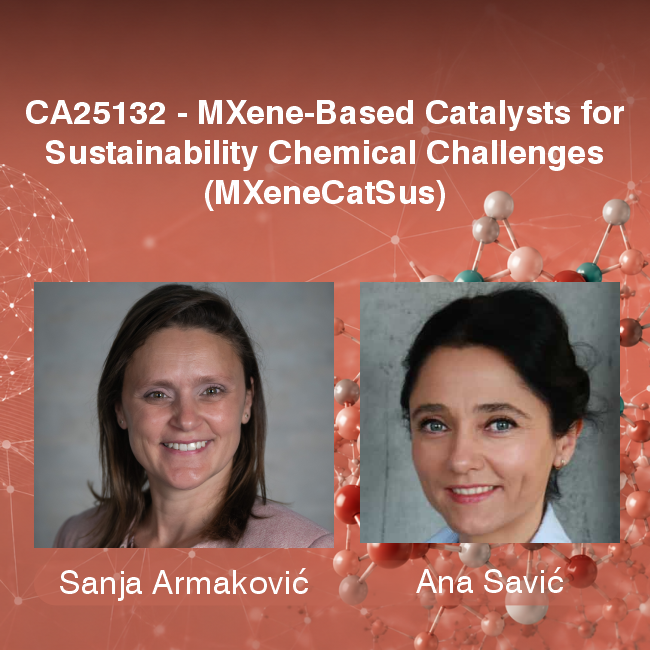
A new European scientific network focused on sustainable catalytic materials will begin its activities in September 2026.
The COST Action CA25132 – MXene-Based Catalysts for Sustainability Chemical Challenges (MXeneCatSus) officially starts on September 15, 2026, bringing together researchers from across Europe with the aim of developing new MXene-based catalytic solutions for some of the major chemical and environmental challenges facing modern society. The Action will run until September 14, 2030.
Among the Serbian representatives in the Management Committee is Prof. Sanja Armaković, member of AIDASCO and researcher at the University of Novi Sad, together with Prof. Ana Savić from the University of Niš. Their participation creates another important connection between AIDASCO-associated researchers and large European scientific networks.
For AIDASCO, this development is particularly relevant because the objectives of MXeneCatSus extend beyond a single research topic. The Action is fundamentally built around international networking, interdisciplinary cooperation, knowledge exchange and the involvement of younger researchers—principles that are also central to the mission of AIDASCO.
A European network for sustainability challenges
Modern societies face a number of interconnected scientific and technological challenges.
The transition toward renewable energy, the reduction of greenhouse-gas emissions, sustainable chemical production, and the development of environmentally responsible technologies all depend on the availability of new materials with improved performance.
Catalysis plays an essential role in many of these processes.
MXeneCatSus focuses on the development of MXene-based catalysts that could contribute to solutions in areas including hydrogen generation, carbon dioxide capture and conversion, and more sustainable routes toward nitrogen-based fertilizers.
MXenes are few-layered two-dimensional materials whose chemical composition and surface properties can be modified for different applications. Their characteristics have already generated considerable interest in thermocatalysis, electrocatalysis and photocatalysis.
The challenge now is not only to identify promising materials, but also to connect research groups with complementary expertise so that materials can be designed, synthesized, characterized, modeled and evaluated more efficiently.
That is one of the central purposes of MXeneCatSus.
Collaboration between experiment and theory
One of the strengths of the new COST Action is its explicit intention to bring together experimental and theoretical researchers.
The official scientific scope includes expertise in theoretical and computational chemistry, materials engineering, nanotechnology, catalysis and environmental engineering. Its key research areas also include computational materials science and machine learning, alongside synthetic procedures, catalytic conversion and MXene materials.
This interdisciplinary structure reflects the direction in which much of contemporary materials research is developing.
Experimental researchers can synthesize and characterize new materials and determine their catalytic performance. Computational researchers can investigate processes at the atomic and molecular level, screen candidate materials, interpret experimentally observed behavior and increasingly use data-driven methodologies to accelerate materials discovery.
The most important advances are therefore likely to emerge not from either approach independently, but through their combination.
Creating the environment in which such collaborations can develop is precisely where international scientific networks become especially valuable.
Sanja Armaković and Ana Savić represent Serbia
The official COST Action structure currently lists Prof. Sanja Armaković and Prof. Ana Savić as the two Management Committee members from Serbia.
The Management Committee coordinates the scientific and networking activities of a COST Action and brings together representatives of the participating countries.
MXeneCatSus currently involves researchers from a broad European network, including institutions from countries across Central, Western, Northern, Southern and Southeastern Europe. Its structure therefore creates opportunities for collaborations that would be difficult to establish within isolated research groups or national projects.
The first Management Committee meeting will take place in Brussels on September 15, 2026, marking the beginning of the Action’s four-year collaborative period.
More than research funding
COST Actions have a distinctive role within European research.
Their central purpose is to create and strengthen research networks.
This means that their value lies not only in scientific outputs, but also in the connections they enable between people, institutions and disciplines.
Such networks can lead to joint publications and research projects, but they also create opportunities for scientific meetings, Working Groups, training activities, knowledge exchange and mobility of researchers.
This is particularly important for young scientists and researchers at earlier stages of their careers.
MXeneCatSus explicitly identifies the development of research and training opportunities for young scientists as one of the motivations for strengthening collaboration between European research groups.
From the perspective of AIDASCO, this represents an especially important aspect of the Action.
International scientific collaboration becomes sustainable only when networks are open to new generations of researchers and when young scientists are given opportunities to participate actively rather than merely observe established collaborations.
Five interconnected areas of activity
The Action is currently structured around five Working Groups:
-
MXene-Based Catalyst Formulation & Preparation
-
Thermocatalysis by MXene-Based Materials
-
Electrocatalysis by MXene-Based Materials
-
Photocatalysis by MXene-Based Materials
-
Communication, Dissemination and Outreach
This structure is important because it demonstrates that MXeneCatSus is not limited to one catalytic technology.
Instead, it connects material preparation with several complementary catalytic applications while also recognizing communication and dissemination as an integral component of scientific networking.
For AIDASCO, the inclusion of communication and outreach is particularly relevant. Scientific results achieve their broader value only when knowledge is exchanged effectively—between research groups, disciplines, institutions and generations of scientists.
Building scientific connections across Europe
The start of MXeneCatSus represents another example of how contemporary scientific challenges increasingly require cooperation that extends beyond individual institutions and national borders.
Problems related to energy, climate, sustainable chemistry and environmental protection are too complex to be addressed effectively through isolated expertise.
Progress depends on combining researchers who understand different parts of the same problem.
A materials scientist, an experimental chemist, a computational researcher and a machine-learning specialist may approach the same catalytic system from very different perspectives. Within a well-structured scientific network, those differences become a strength.
This principle is closely aligned with AIDASCO’s broader objective of supporting the international development of academic and scientific collaboration.
Participation of AIDASCO-associated researchers in initiatives such as MXeneCatSus helps establish new connections between institutions, creates possibilities for future collaborative activities, and provides additional pathways through which younger researchers can become involved in international science.
Looking toward four years of collaboration
The Brussels meeting on September 15 will represent only the beginning.
Over the following four years, MXeneCatSus will work toward establishing an organized European network capable of advancing MXene-based catalyst research through the combined efforts of experimental and theoretical scientists.
For AIDASCO, we are particularly pleased to see researchers connected with the Association participating in initiatives that bring together scientific excellence, international cooperation, sustainability and opportunities for young researchers.
These are precisely the kinds of connections that can transform individual research activities into lasting international scientific communities.
COST Action CA25132 – MXene-Based Catalysts for Sustainability Chemical Challenges (MXeneCatSus)
September 15, 2026 – September 14, 2030
More information about the Action, its scientific objectives, Management Committee and Working Groups is available on the official COST Action CA25132 webpage.